LS #50 · Learning From the Masters

A Visual Companion

June 2026 · Creative Path Academy

Why Learn From the Masters?

One of the best ways to grow as a photographer is to look hard at work you admire. Not to copy it, but to enrich your visual vocabulary. Painters, novelists, musicians, photographers, they are all doing the same thing. They have something inside, an idea, an emotion, a story, and they find a way to express it so you can return to it again and again. That sense of wonder on repeated viewing is what separates a record from a work of art.

Tonight we looked at two of the photographers who shaped me most: Philip Hyde and Brett Weston. They are different in almost every way, and committed to the same thing. Neither one merely recorded what was in front of him. They interpreted it. Every choice about what to leave out and where to lead the eye was a choice about what they wanted you to feel. And feel is a more powerful word than see.

Philip Hyde

  • He came out of the most interpretive lineage there was. He studied with Ansel Adams, Minor White, Edward Weston, Imogen Cunningham, and Dorothea Lange, and he took Minor White's idea of equivalence to heart: what you felt is what you put in the photograph.
  • He was quiet where Ansel was loud. He chose restraint and reverence over drama, and that calm was a decision, not a limitation.
  • He was the Sierra Club's lead photographer for decades. He didn't photograph a place for accuracy. He photographed it to make you feel it was worth saving.
  • A master of the vertical frame and deep space, ranking foreground, middle, and distance so the eye always knows where to travel.
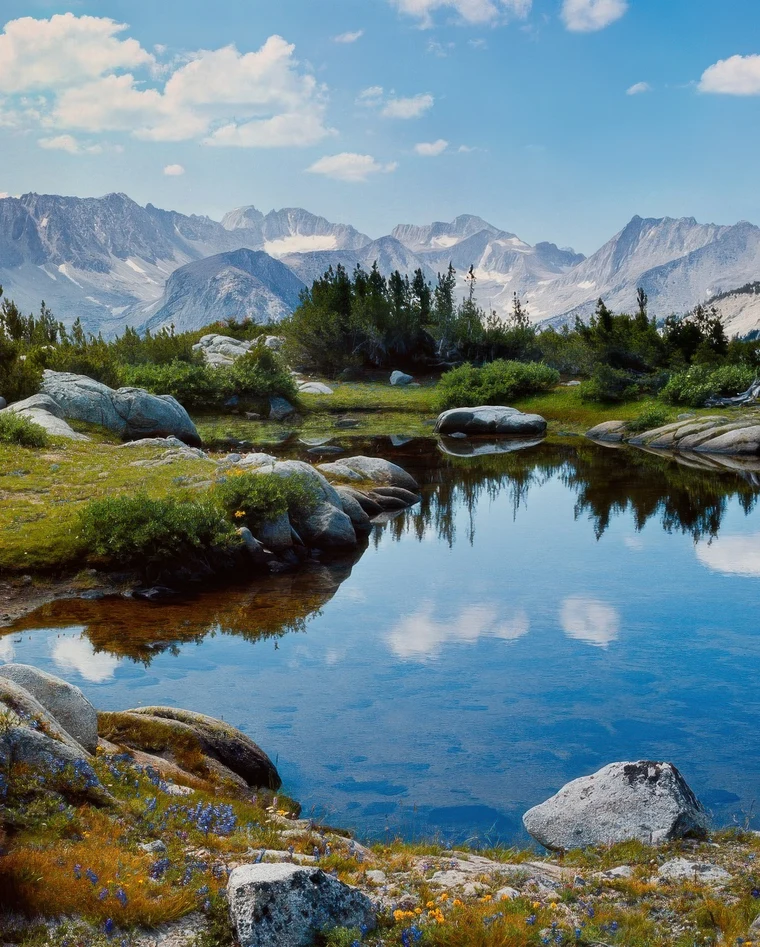
Color vertical photograph of a clear alpine lake reflecting jagged peaks and clouds, with granite boulders and wildflowers in the foreground.

© Philip Hyde

A vertical, and a master class in design. There is no such thing as vertical or horizontal in terms of the camera. It only serves the composition. The frame moves you through repeating shapes, boulders up to trees, mountains, and clouds that echo the foreground. The space he leaves with the water slows the eye before the texture picks it back up. Everything has its place in the hierarchy, so when you reach the back you are happy to return and explore again.
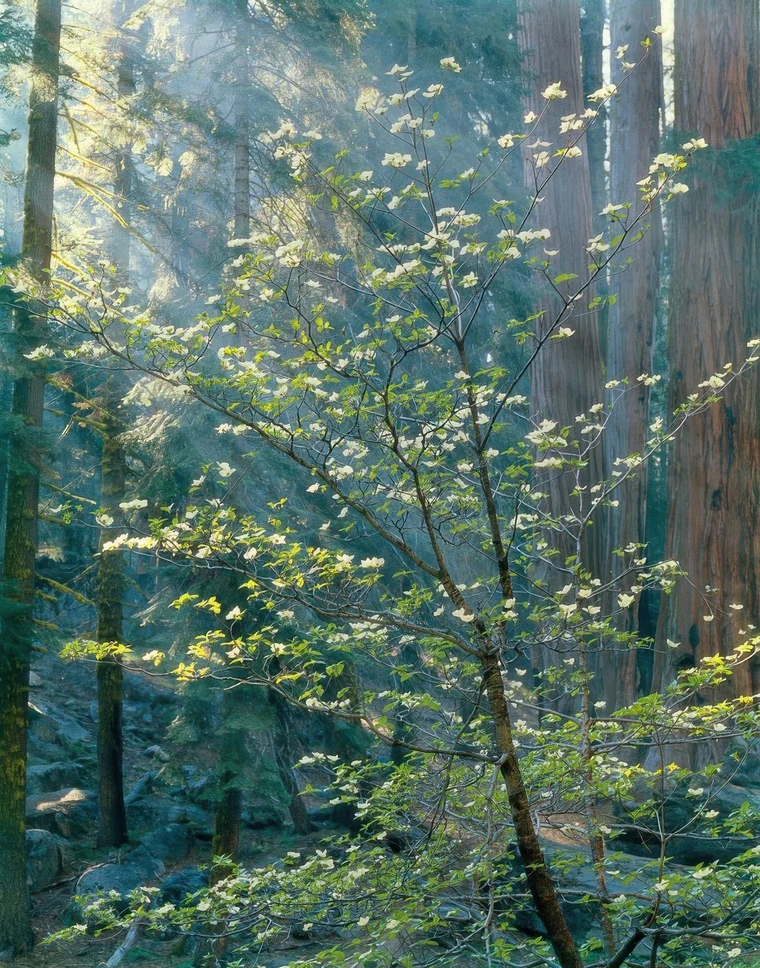
A flowering dogwood reaching diagonally toward shafts of light in a shadowed forest of tall dark trunks.

© Philip Hyde

Something bright on the edge of the frame, which I tell you to be careful with. Be careful, not never. That single tree leaning toward the light is the one diagonal in the picture. Everything else stands vertical and static, so the lean becomes the whole image. I couldn't circle a center of interest on any one tree. The subject isn't a thing, it is the reaching. The trees behind only give context.

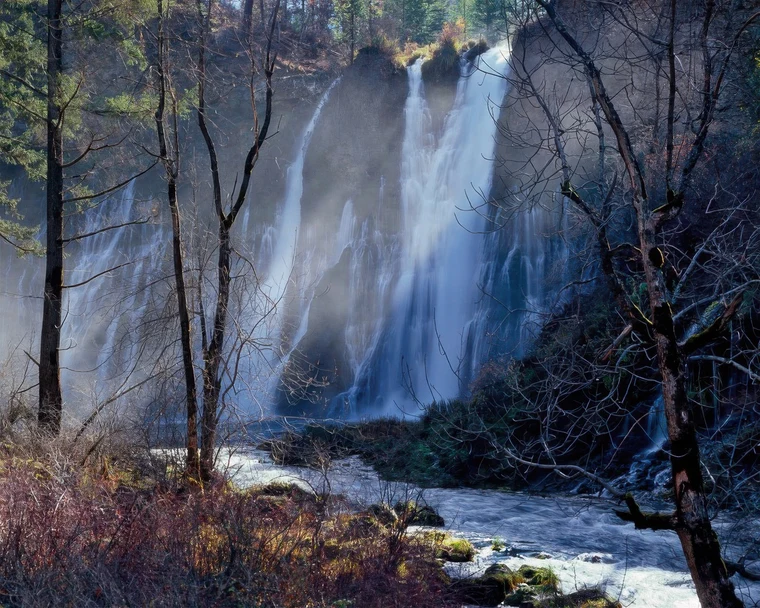
A horizontal photograph of a misted waterfall framed by bare trees, a river running across the foreground, color held to muted greens and earth.

© Philip Hyde

A horizontal this time, and what I love is the restraint in color. There is color, but it is so reserved that it says more than a saturated frame ever could. The waterfall reads first, the framing trees second, and the angled tree points you back in. Another bright edge, but he stops it with a tree instead of letting it run into the corner, and balances it against all that falling water. He is faithful not to what the place is, but to how he saw it.

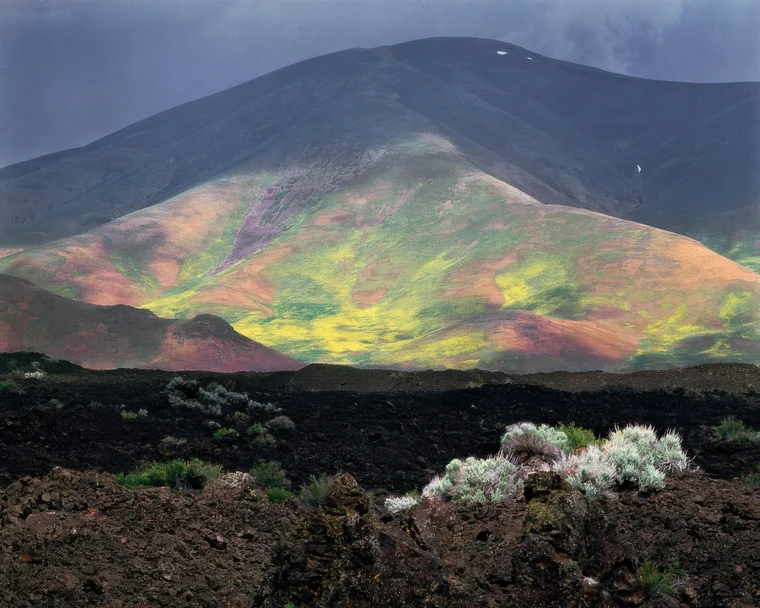
Soft pastel light of yellow, green, and rose sweeping across distant hills above a dark volcanic foreground dotted with pale sage.

© Philip Hyde

This one is about depth and restraint. The foreground feels close, the background almost unreal with that pastel light, and yet nothing is overdramatized. You have to look into it. He builds it in layers: a shape that lifts a patch of plain ground, a second layer in shadow you have to find, a thin lit strip, then the open space. The top fades into soft, dreamy nothing that brings you back down. Make those clouds loud and you would lose the whole point.

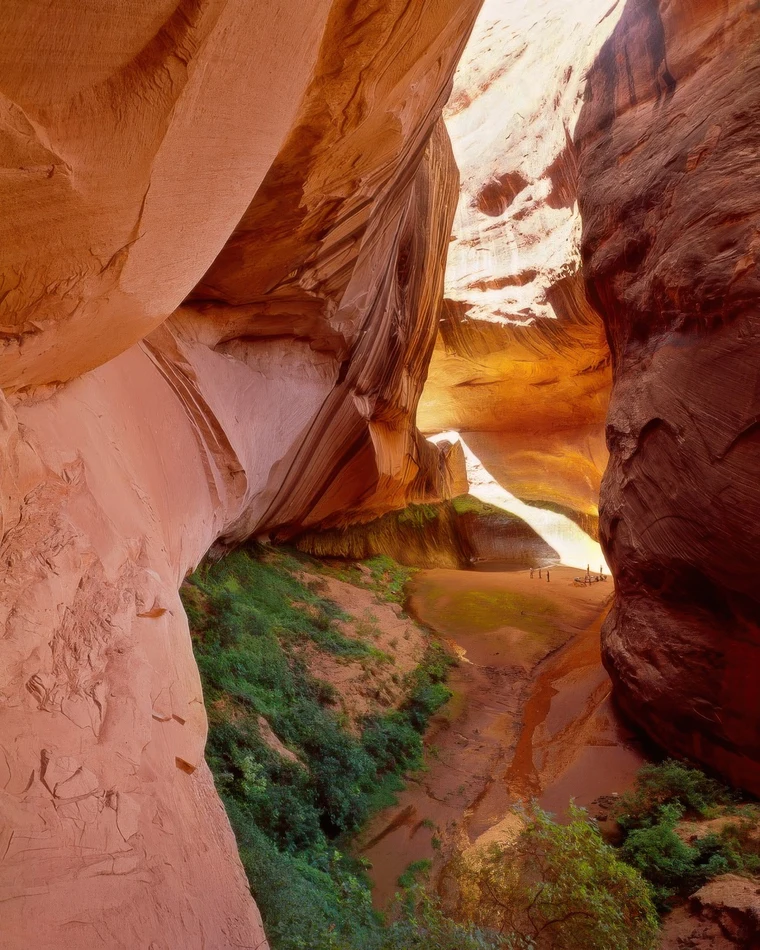
Color vertical view inside a towering sandstone chamber, light pouring from above, tiny human figures standing at the base for scale.

© Philip Hyde

Another vertical with a bright passage running to the top edge, but what makes it is the people at the bottom. Suddenly the scale is overwhelming. This is his cathedral, and the light points you down to the figures while the tones keep your eye moving, darkest below, highlights above. Notice the details on the ledge, small enough to hold in your hand, against the immensity of the space. Most people don't see the figures at first. Neither did I, and that discovery is part of the picture.

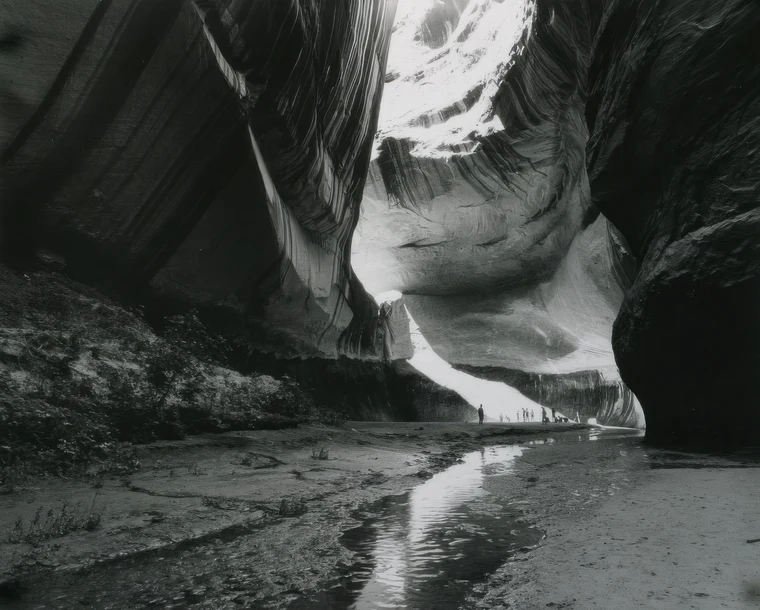
Black-and-white view inside a vast sandstone canyon, a wet channel leading the eye toward small silhouetted figures in the brightest passage.

© Philip Hyde

The same idea in black and white, and now he leads you to the people even more clearly. A line runs in from the foreground, and he sets the figures in the highest-contrast passage, where the eye always goes. The rest is just broad shapes setting the stage. He is not opening the shadows to show you every rock. He knows exactly what he wants you to see, and keeps everything else secondary so the story stays clear.

Brett Weston

Where Hyde interprets through restraint, controlling color and using the frame to walk you through the land, Brett Weston goes the other way. He bends form and tone until you cannot mistake the picture for a copy. Opposite moves, the same refusal to record. His set runs from the conventional toward pure abstraction, and you can watch the idea sharpen as it goes.

  • Edward Weston's second son. He started shooting at fourteen, exhibited as a master in his late teens, and many thought him the finer printer of the two. In his day the only way to see a photograph was as a print, so the print was the skill.
  • On his eightieth birthday he burned a large portion of his negatives so no one could print them after he was gone. He believed only he could interpret them. The negative is the score, the print is the performance, and he thought only the photographer should perform it.
  • He left most of his work untitled. A title tells you what to think and limits the picture. No titles, no negatives, the same conviction all the way down.
  • He was subject-agnostic. He could find a photograph anywhere, even a parking lot. The seeing was the thing, never the subject. He worked from feeling and instinct, not from intellectualizing.
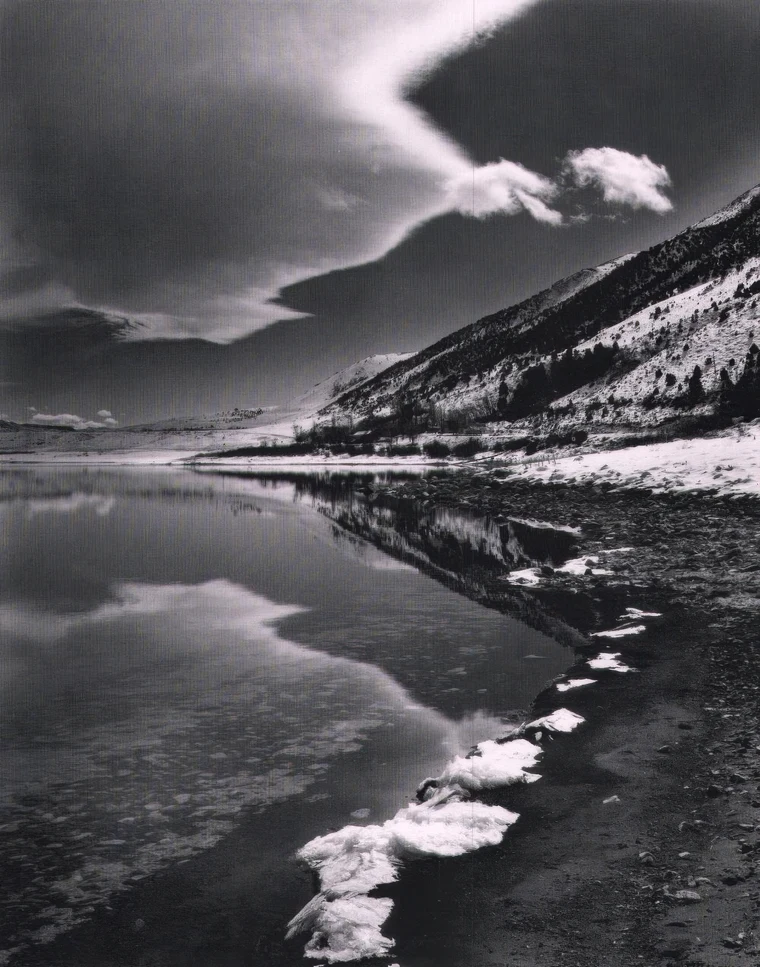
Black-and-white vertical landscape of a still lake, a large cloud form echoed by its reflection, ice along the shoreline, a dark ridge at right.

© Brett Weston

Another vertical, another beautiful lead-in. That cloud is almost perfectly repeated in the form of the water below it; he composed the frame so the two echo. The blacks are held down to keep those areas quiet and simple. No rule of thirds here, the horizon sits dead center, and it doesn't matter. He composed for the strongest movement through the frame, not the rule. The feeling is the thing, cloud and land and reflection working as one.

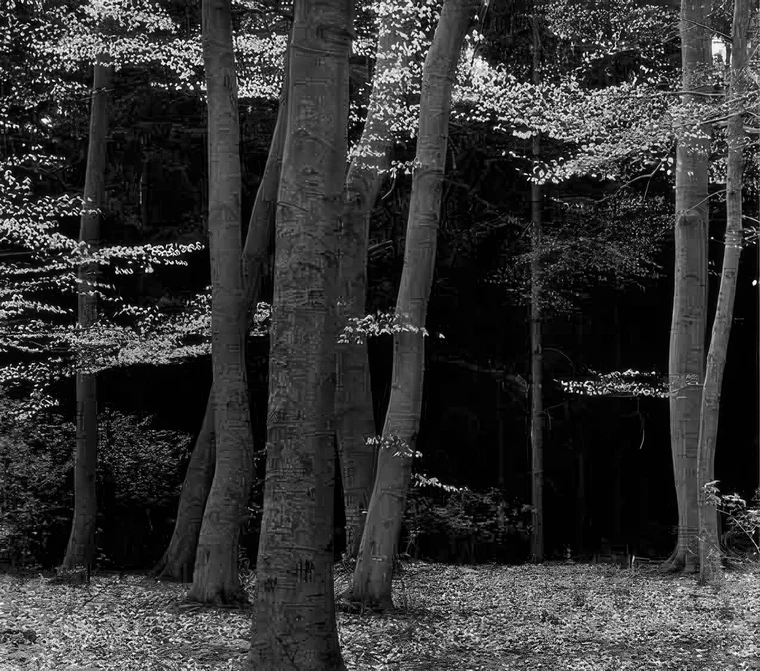
A cluster of dark slender elms with pale leaves, set against a background pushed almost to black, one trunk cut off at the bottom edge.

© Brett Weston

Deep shadow used as a compositional tool, not an accident of exposure. The trees are dark, yet they stand out, because he pushed the background even darker and let it fall away. There is a conversation between these groups of trees, clear because the darks make it obvious, and few of them sit in the same plane. One is cut off at the bottom entirely, suggesting where it is grounded rather than showing you. That has to be intentional, and it works because the group is stronger than any single tree.

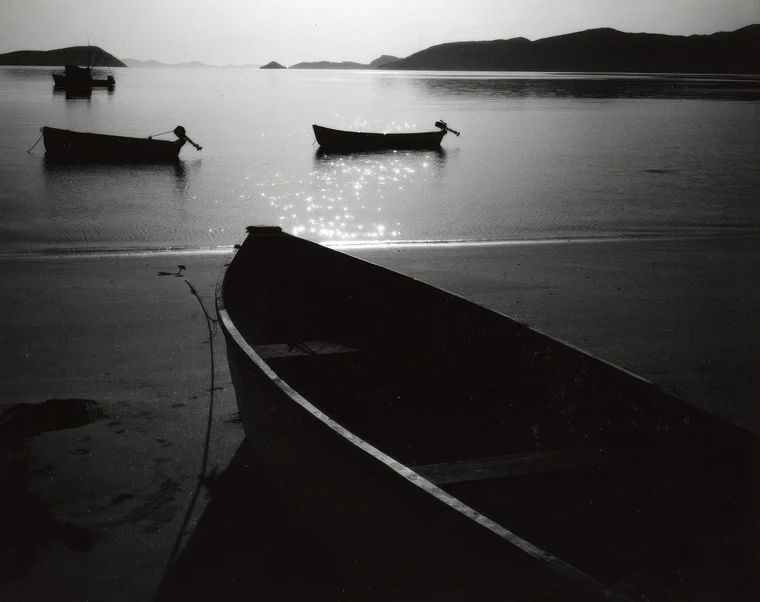
Dark silhouetted boats on a bay, heavy shadow in the foreground, scattered bright glints of light skimming the water.

© Brett Weston

Now toward abstraction, interpreting through tone and mood rather than form. The deep darks give the foreground weight, and those sprinkled highlights on the water are the highest-contrast note in the frame. A larger dark shape pulls you back the other way, and you drift through the harbor. It does not matter what is inside the boats, or their color. The point is what it feels like to stand here with the light skimming the water. He has taken away everything that doesn't answer that.

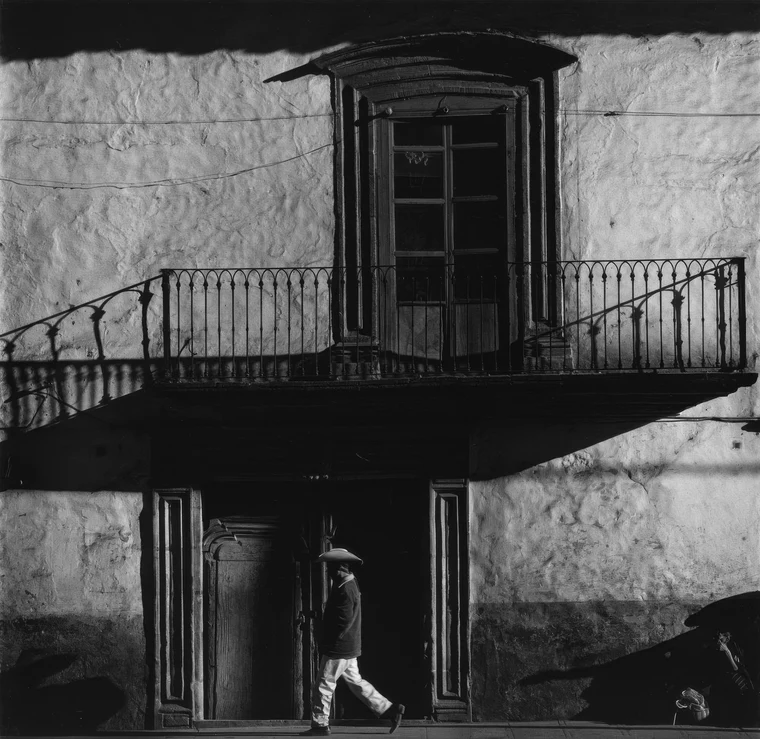
Architectural facade flattened into blocks of light and dark, a balcony reading as a pale trapezoid, a small figure crossing below.

© Brett Weston

Here he treats the whole frame as a flat canvas for shapes. The balcony juts out in three dimensions but reads as a flat trapezoid, built from light and dark. A figure walks across for scale, and someone else watches from the shadows for mystery. Sparse and controlled, but not empty, with real texture held in reserve. This is the bridge image. Rock, driftwood, a building, a person, the same eye. It was never a nature lesson. It is a seeing lesson.

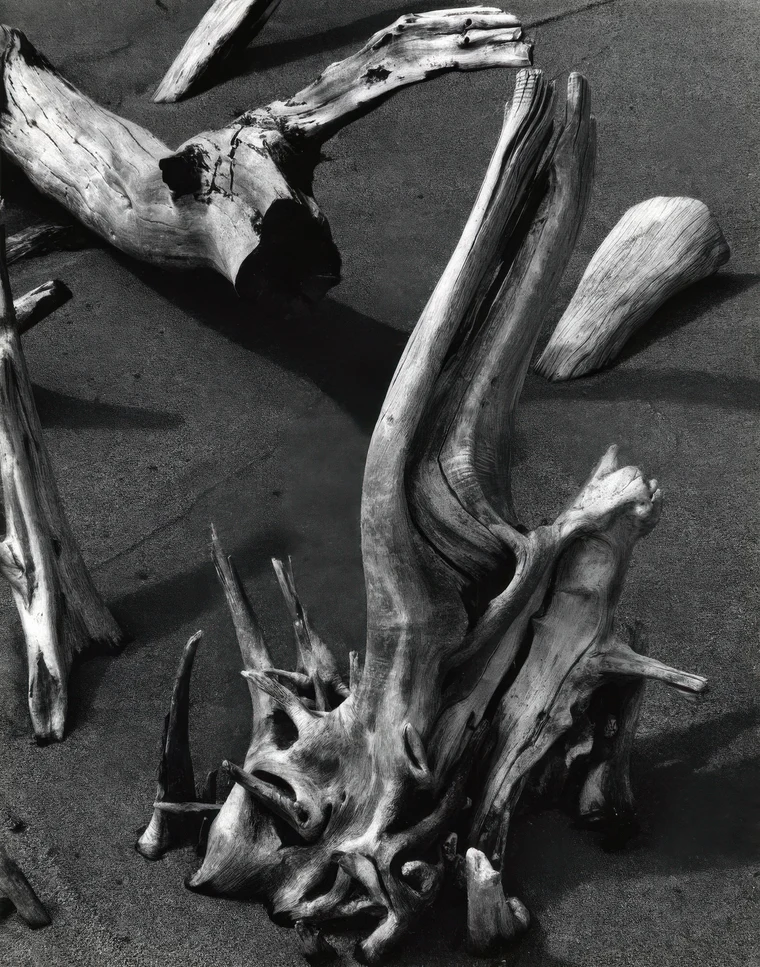
A weathered driftwood root reduced to pale curving lines and gesture against smooth, simple sand, one edge running off the frame.

© Brett Weston

Distilled further, seeing at full strength. The root becomes pure line and gesture. You can't even tell how big it is, and that is deliberate. At a glance you follow the curve to the diagonal, and the longer you look the more you find. He lets a piece run off the frame, the same move as the cut tree, so you wonder where it goes. The background is just smooth sand with one small mark for tension. The shape feels almost alien, which is exactly what he is after.

Near-abstract photograph of sunlit dunes, the frame divided into interlocking shapes of bright highlight and deep shadow.

© Brett Weston

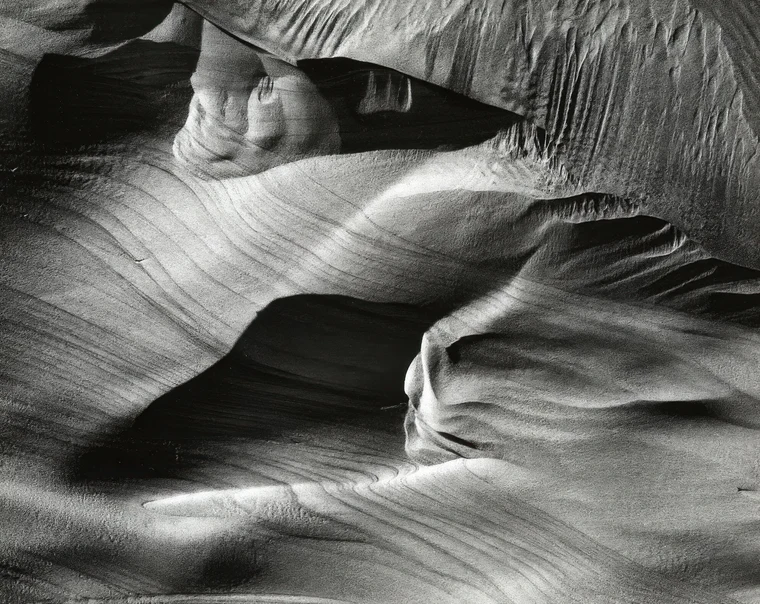
One last image, close to pure abstraction. It doesn't matter that you can't name it, and chasing that misses the point. It is about form, light, and tone. The shadows do as much work as the highlights, so you can read the picture twice, once by the lights and once by the darks, and invert between them. Look long enough and the subtleties keep coming, faint lines in the shadow, a little light buried in the dark. That reward on repeated viewing is a lot of what makes something worth calling art.