The Completion Loop
I’ve been thinking about something strange.
Everyone’s talking about the “Year of Analog.” Vinyl sales are up. Film cameras are selling at ridiculous prices. There’s a cultural hunger for things you can hold, things that take up space, things that exist whether or not you’re looking at your phone.
And yet most photographers I know still experience their own work primarily by scrolling past it on a screen.
Think about what we do: we wake up early, drive hours to a location, stand in cold wind waiting for light that may never come. We compose with intention, wait for the right moment, press the shutter. Then we spend hours editing, refining, trying to make the image match what we felt in the field.
And then what? We export a JPEG and perhaps post it somewhere. If you’re not sharing your work online, then it’s even more confined to a digital realm that doesn’t really let you do what I’m calling, “close the creative loop.”
The creative loop never closes.
I was talking with a friend who collects vinyl records, and he said something that stuck with me: “There’s something physical about vinyl that doesn’t happen with streaming…you can’t just listen in the background. The format demands your attention.”
That’s when it clicked. The print does the same thing for photography.
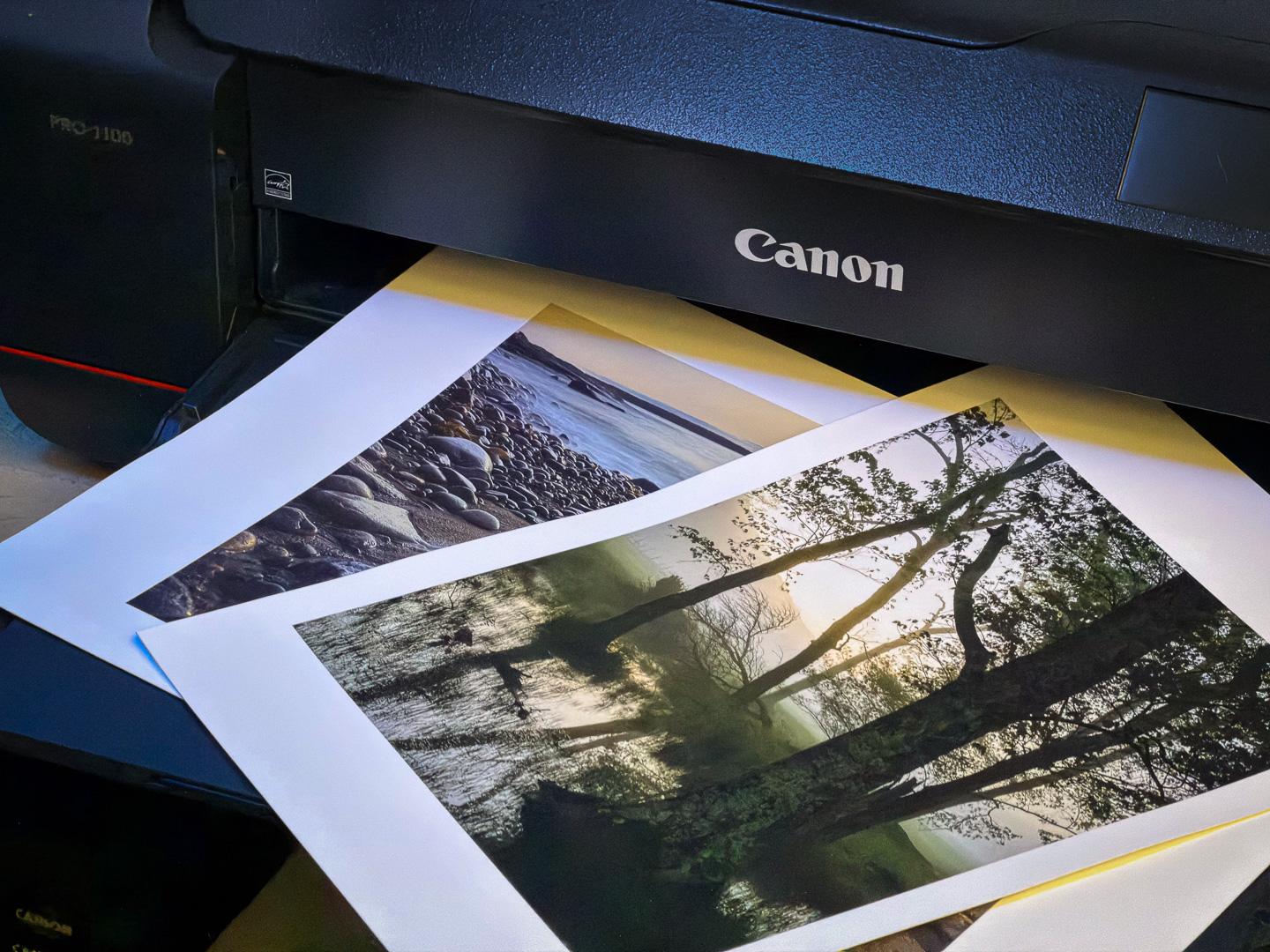
When I commit an image to a beautiful Canson Infinity paper, something shifts. The image stops being data and becomes an object. It takes up space. It demands a decision: is this worth hanging? Worth framing? Worth looking at repeatedly?
Most of my images don’t survive that question. And that’s the point.
“Instructions for living a life: Pay attention. Be astonished. Tell about it.” – Mary Oliver
A print gives you something a screen can’t: presence. The image exists in the room with you. Weak compositions become obvious, and tonal choices you glossed over demand a verdict. But the images that do work—the ones that hold up as physical objects—those are the ones that matter.
Printing also changes how you photograph—knowing that an image might become physical—that it might have to justify itself as an object—changes how I see. I’m less interested in capturing everything and more interested in feeling something worth making permanent.
In a world where anyone can generate thousands of images in seconds, the ones you’re willing to make physical say something about what you actually care about. That can’t be automated.
Share your feedback, thoughts, and questions below!
Free Webinar
If this resonates with you, I’m offering a free webinar on Jan 22nd at 2PM EST titled “Getting Started With Fine Art Printing”—the gear, the workflow, the decisions that actually matter.
In the meantime, if you want to explore printing more deeply, the Academy includes regular Print Lab sessions where we work through the entire process together.