
The Only Thing That Ever Made a Great Photograph
Kevin Kelly has been photographing seriously for 55 years. He’s the founding executive editor of Wired magazine, a futurist, a prolific author (including photography books), and someone who has thought as carefully about technology as almost anyone alive. Here is what he recently said about his camera:
“I’ve been seriously photographing for 55 years and the best camera I’ve ever owned is the iPhone 17 Pro. The sensor is the clearest, most sensitive, most color true I’ve ever had. It has near infinite capacity and a great battery. And most important to me is its range of lenses including wide-angle and a new optical telephoto lens that zooms to 200mm equivalent. Awesome! The whole kit fits into my pants pocket so I always have my best camera at hand. I no longer use any other camera outside my studio.” — Kevin Kelly
Read that again. Fifty-five years of experience, all of it pointing at a device that fits in your pocket. Here’s what I’ve come to believe after twenty years behind a camera myself: the technology was never the bottleneck. It always has been, and will be our ability to use it creatively.
I’ve been shooting with my iPhone alongside my mirrorless camera for several years now, and what I keep running into are people who are surprised when they see the results. I’ve made prints at 13×19 and 17×22, and brought them to photo conventions. People examine them closely, and nobody can tell. At some point you have to sit with that fact for a moment.
The technology in a current iPhone is, as Kelly puts it, extraordinary. The computational photography, the automatic exposure, the deep fusion processing that happens before the RAW file even gets captured—all of it is working hard to guarantee a technically sound image. And it definitely delivers.
But here is the thing I say to every Academy member who asks about gear: a technically sound image is not the same as a meaningful one. The computational photography can read the light, but it cannot read the scene. It can gather information about everything in front of the lens, but it cannot decide what matters.
It can’t feel the tension between the warm light on the leaves and the cool reflection of the sky overhead. It cannot choose to move two steps to the left because doing so removes a distraction that was pulling the eye away from what the image is actually about.
That part is still yours. It was always yours.
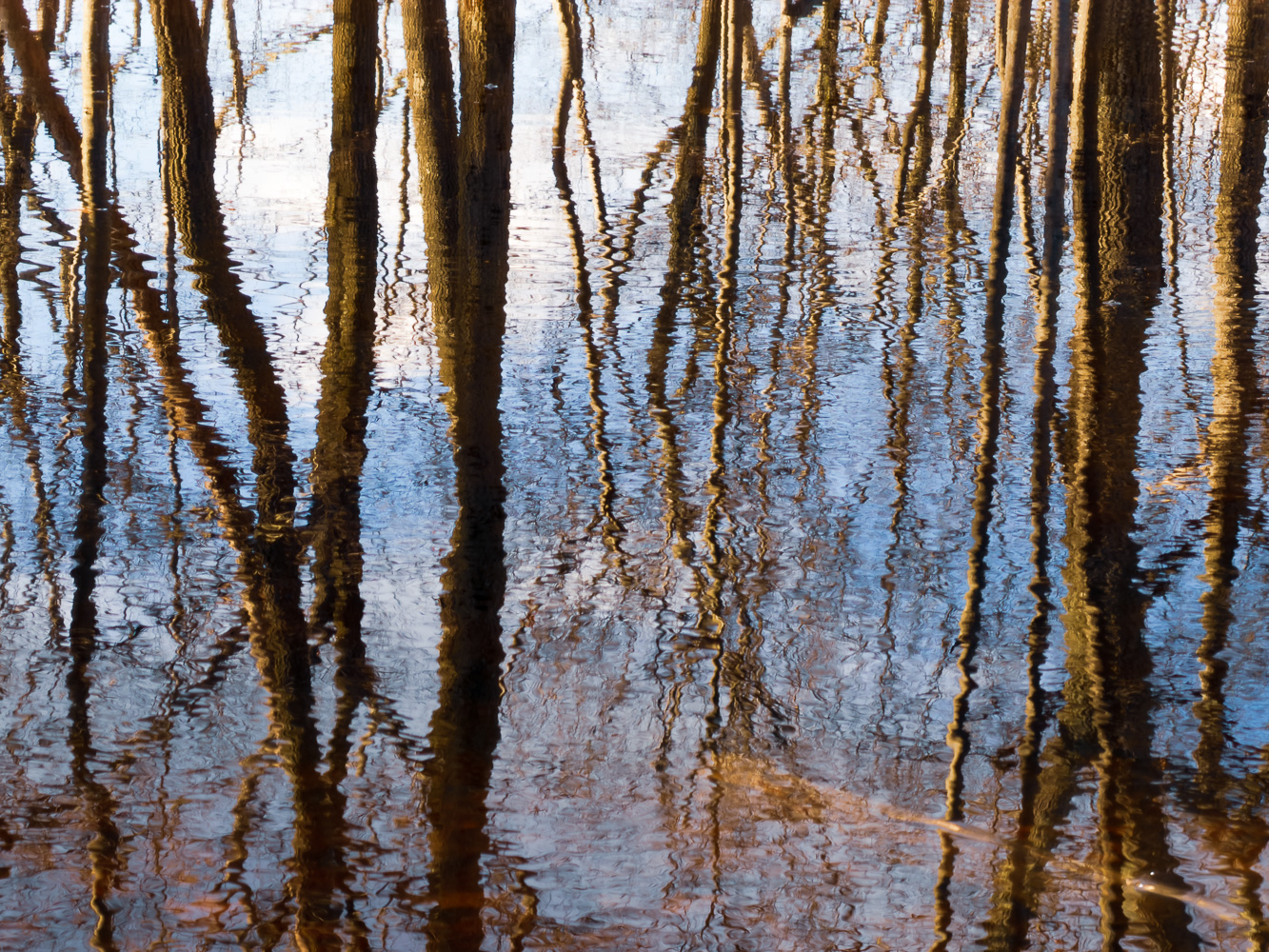
I was out with my dog one morning recently, not really intending to photograph anything in particular, just open to whatever I came across. We found a shallow pond after some rain, the kind of still water that holds the sky and the ground at the same time, and I spent twenty minutes with my iPhone just exploring it.
I made images with sharp water and frames with motion blur. I tried a longer exposure to soften the surface into something more painterly. I moved closer and then farther back, simplifying and then complicating. Every exposure was perfect, but the phone didn’t tell me what to notice or why it was worth noticing.
When I look at the images I kept from that morning, what separates them from the ones I discarded has nothing to do with sensor quality or megapixels. It has to do with what was included and what wasn’t. It has to do with the moment when the lines in the water aligned in a way that felt right, and I recognized it and pressed the shutter. That recognition is a skill that can be developed. But it is not something you can upgrade your way into.
This is, I think, what Kelly’s quote is really pointing at, even if he doesn’t say it quite this way. The reason the iPhone is his best camera is not that it outperforms everything else on paper. It’s that he has 55 years of knowing how to see, and the iPhone removes every obstacle between that seeing and the image. The camera becomes transparent. What’s left is just him and the world in front of him.
That’s the goal. Not better gear—better seeing. And the good news is that seeing, unlike sensor technology, is something you can actually improve.
At the Academy, a lot of what we do in live sessions is exactly this kind of work: looking at images together and understanding what makes them land or fall apart, independent of how or where they were captured. If that kind of focused attention to vision is something you’re looking for, you’re welcome to come take a look.
Hi Robert.
Thank you for your most informative and inspiring article! I certainly appreciate your many thoughtful points. As a landscape, wildlife and product photographer, I strive to capture nature (and small products) with as much sharpness and detail as possible, and since I often print large, I prefer using either full frame or APS-C sensors combined with very high-quality lenses.
Though I have an iPhone 14 Pro, I prefer to use my Nikon or Fujifilm gear for my “serious” work. That said, your points of “seeing” compositionally is something that must be done by the photographer rather than the technology. Thanks again!
Thanks for the feedback Steve, appreciate it!